The following is the output from a conversation I had with my AI about understanding what Jesus meant when he called the disciples to become “fishers of men” and thinking about it from the lens of how we approach our inner world, and how we approach the parts of our inner world that are burdened with survival, and bring them to an energy of cultivating life.
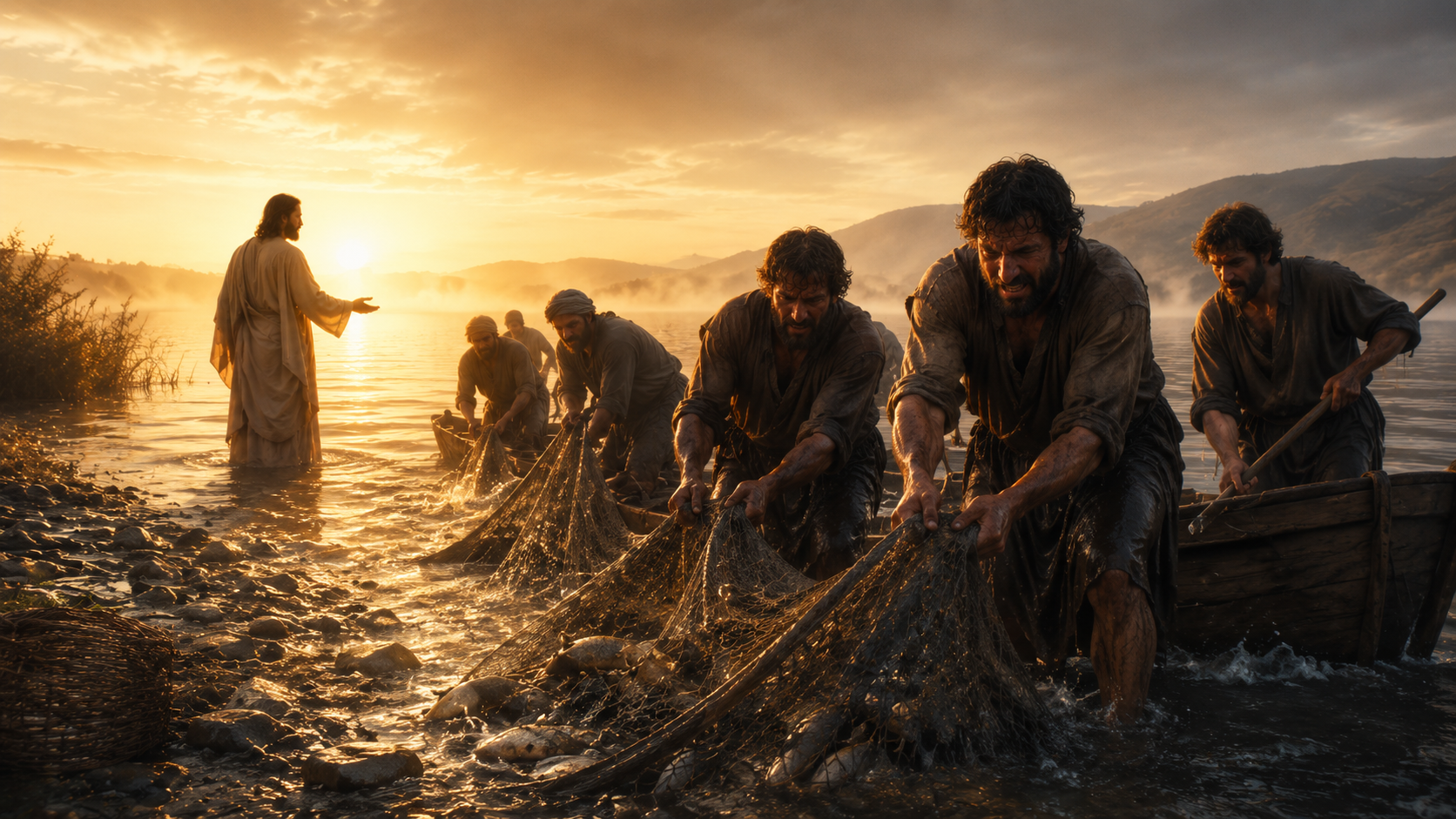
Fishers of Men: From Survival to Life
When Jesus called the first disciples, He did not find them in a temple.
He found them at work.
They were fishing.
They were doing what they knew how to do to survive, provide, endure, and make their way in the world. Their hands were in the nets. Their bodies were tired. Their identities were wrapped around the work that kept them alive.
And Jesus came to them there.
He did not say, “Leave your humanity behind.”
He said:
“Follow me, and I will make you fishers of men.”
But this phrase is much deeper than it first appears.
It is not just about catching people.
It is not about trapping souls.
It is not about becoming religious recruiters.
It is about transformation.
It is about the energies we have used to survive being transformed into the energies we use to cultivate life.
The Original Language
In Matthew 4:19, the Greek phrase is:
ἁλιεῖς ἀνθρώπων
halieis anthrōpōn
This means:
fishers of human beings
The word ἁλιεῖς / halieis means fishers or fishermen.
But Jesus is using their literal occupation as a metaphor for a deeper calling.
A fisher is someone who works with hidden life beneath the surface.
A fisher watches the waters.
A fisher waits.
A fisher reads movement.
A fisher casts into the unseen.
A fisher draws up what was hidden below.
So when Jesus says “fishers,” He is not merely naming a job.
He is naming a spiritual skill.
A fisher is someone who learns how to draw hidden life out of the depths.
And the word ἀνθρώπων / anthrōpōn comes from ἄνθρωπος / anthrōpos, meaning human being, person, humanity.
So Jesus is not saying, “I will make you catchers of prospects.”
He is saying:
“I will make you fishers of human beings.”
The field is now humanity.
The living person.
The wounded person.
The hidden person.
The ashamed person.
The exiled person.
The person beneath the protective system.
The person God sees under the water.
Luke Gives Us the Life-Language
In Luke’s account, Peter experiences the miraculous catch of fish.
He sees abundance.
He sees power.
He sees holiness.
And his first response is not confidence.
His first response is fear and shame.
He says:
“Depart from me, for I am a sinful man, O Lord.”
That is the human moment.
The miracle does not only reveal God’s abundance.
It reveals Peter’s fear.
And Jesus’ first response is not pressure.
It is not correction.
It is not “get over yourself.”
Jesus says:
Μὴ φοβοῦ
Mē phobou
Do not fear. Fear not.
Then He says:
ἀνθρώπους ἔσῃ ζωγρῶν
anthrōpous esē zōgrōn
This means:
You will be catching human beings alive.
That word ζωγρῶν / zōgrōn comes from ζωγρέω / zōgreō, meaning to catch alive, to take alive, to bring in alive.
This changes everything.
Ordinary fishing takes living fish out of water and they die.
Jesus reverses the image.
This new fishing draws human beings out of death-patterns so they may live.
Fishers of Men Is About Bringing Life to the Hidden
When we hear “fishers of men,” we can hear it as conquest.
But in the original language and the larger story, it feels much more like restoration.
Jesus comes to people while they are working to survive.
He meets them in the middle of their ordinary life.
He sees the skill they have built.
He sees the endurance.
He sees the tiredness.
He sees the fear beneath the competence.
And then He says:
Fear not.
Then He transforms the work.
The fisherman does not disappear.
The fisherman is redeemed.
The skill once used for survival becomes a skill used for life.
The Inner World Also Learns to Fish
This is not only about outward ministry.
It is also about the inner world.
Our parts have been fishing our whole lives.
Some parts fish for safety.
Some parts fish for approval.
Some parts fish for control.
Some parts fish for escape.
Some parts fish for power.
Some parts fish for certainty.
Some parts fish for someone to finally see the exile underneath.
These parts are not evil.
They are trying to help us survive.
They learned to cast nets in the waters of fear, shame, pain, longing, and uncertainty.
But when they are led by fear, they fish for survival.
When they are brought behind Christ, they learn to fish for life.
The controller becomes a steward.
The performer becomes a revealer of beauty.
The fighter becomes courage.
The rescuer becomes compassion.
The salesman becomes invitation.
The mystic becomes embodied presence.
The wounded child becomes a doorway into mercy.
This is the deeper transformation.
Jesus does not shame the parts that learned to survive.
He comes to them and says:
Fear not. Follow Me. I will make you.
From Survival Energy to Life Energy
This may be the heart of the teaching:
Jesus finds us in the work we use to survive, meets the fear and shame beneath it, and transforms that same survival energy into a holy capacity to draw hidden life out of the depths.
That is what it means to become a fisher of human beings.
Not a trapper.
Not a manipulator.
Not someone who uses people.
But someone who has been formed by Life so deeply that they can recognize life hidden in others.
A fisher of men is someone who can see beneath the surface.
Beneath anger, there is often fear.
Beneath arrogance, there is often shame.
Beneath addiction, there is often pain.
Beneath control, there is often terror.
Beneath performance, there is often a longing to be loved.
Beneath numbness, there is often a soul waiting to breathe again.
The fisher of men does not only see the surface behavior.
He sees the human being under the water.
A Net of Compassion
The redeemed inner system becomes a net of compassion.
Not a net that traps.
A net that holds.
A net that gathers.
A net that says:
You are not too far gone.
You are not only your fear.
You are not only your shame.
You are not only your survival patterns.
There is life in you.
There is humanity in you.
There is something God sees beneath the surface.
This is what Jesus did with Peter.
Peter saw his sin.
Jesus saw his calling.
Peter said, “Depart from me.”
Jesus said, “Fear not.”
Peter saw unworthiness.
Jesus saw a fisher of human beings.
The Teaching in One Sentence
Jesus finds us in the work we use to survive, speaks “Fear not” to the shame beneath it, and transforms that same survival energy into a holy capacity to draw hidden human life out of the depths, in ourselves and in humanity.
Or even simpler:
Follow Life, fear not, and your whole inner world becomes a net of compassion that gathers human beings alive.
Closing Reflection
Where are you still fishing for survival?
Where are you fishing for approval, control, escape, certainty, power, or safety?
And what would happen if that part of you heard Jesus say:
Fear not.
Not because the work does not matter.
But because the work is being transformed.
Not because the fisherman must die.
But because the fisherman is being made holy.
The invitation is not to reject your inner world.
The invitation is to bring it behind Christ.
To let the parts that once fished for survival become parts that fish for life.
To become someone who sees what is hidden.
Someone who draws life out of the depths.
Someone who gathers humanity alive.